








In the world of CNC milling machines, moving from a traditional 3-axis setup to a machine equipped with a 4th axis is not just a technical detail—it’s a true paradigm shift. Whether you are an industrial manufacturer, craftsman, or digital fabrication enthusiast, understanding what 4-axis CNC really means can transform the way you design and produce complex parts.
This article explores four-axis machining, explains why it is becoming a major asset in modern workshops, and highlights how certain machines fit into this growing trend.
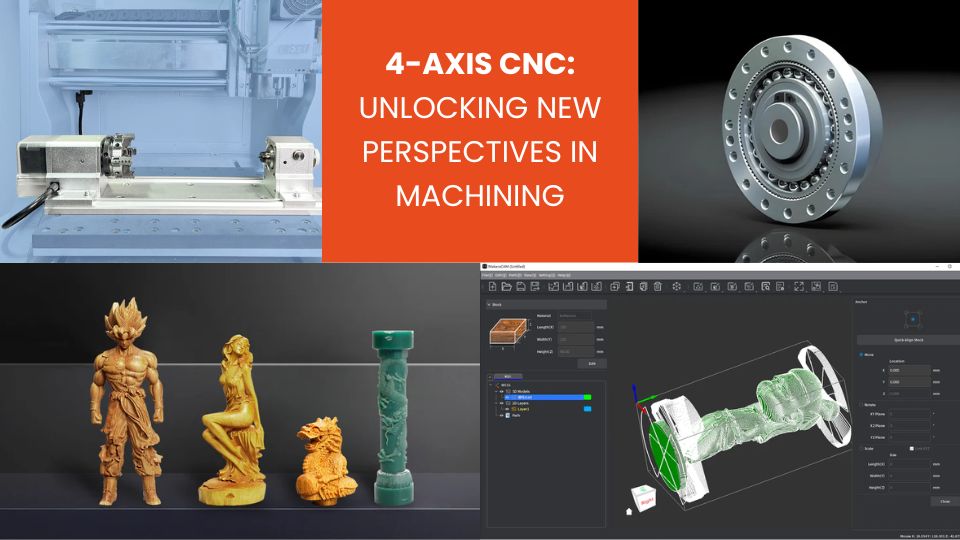
What Is a 4-Axis CNC Machine?
Traditionally, a CNC milling machine moves along three directions: X (left/right), Y (front/back), and Z (up/down). This configuration is sufficient for the vast majority of simple machining operations or “flat” geometries.
However, as soon as you approach more complex geometries, patterns around a cylinder, multi-face parts without manual repositioning, or angled profiles, the 3-axis approach quickly reaches its limits. A 4-axis CNC machine therefore adds a rotational axis, usually referred to as the A-axis, which rotates the workpiece around one of the linear axes (often the X-axis). This rotational movement allows machining all around a cylindrical volume or accessing additional faces without manually repositioning the part.
On a 4-axis CNC:
- – X, Y, and Z movements remain available,
- – the A-axis enables workpiece rotation, expanding machining possibilities.
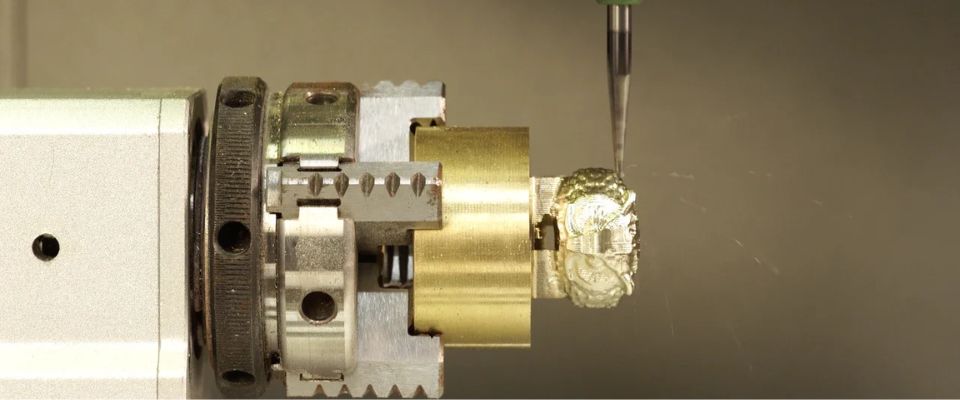
Traditional Machining vs. 4-Axis Machining
To better understand the difference, imagine a part such as a shaft or a complex cylinder. On a 3-axis machine, you generally need to:
- position the part,
- machine one face,
- manually reposition the part afterward,
- repeat the process for each face.
With 4-axis machining, thanks to the rotary axis, the part can be machined in a single setup, with the tool working on all sides as the workpiece rotates. This reduces alignment errors, minimizes downtime between setups, and improves overall precision.
Why a 4th Axis Changes Everything
Machining More Complex Parts
The most obvious advantage is the ability to produce shapes that 3-axis machining simply cannot easily achieve. Symmetrical objects around a central axis, helical profiles, patterns around circular bores, or multi-face components can be manufactured far more efficiently.
Reduced Setup Time
On a conventional machine, each change of face requires repositioning the part, recalibrating the origin, and checking settings. With 4-axis machining, the integrated rotation often eliminates these intermediate steps. This reduces not only setup time but also the risk of human error.
Improved Accuracy
By keeping the part clamped in a single setup and precisely controlling its rotation, dimensional deviations between faces are minimized. This is particularly valuable in industries where tolerances are critical, such as aerospace, automotive, or the production of specialized technical components.
Ideal for Small Batches and Prototyping
4-axis machines are especially well suited for prototyping and small-batch production, where flexibility and responsiveness are more important than high-volume throughput.
Practical Applications of 4-Axis CNC
To make it more concrete, here are some examples where a 4th axis truly makes a difference:
Gears, shafts, bearings: machining cylindrical parts with details around the perimeter.
Multi-face brackets: complex components requiring drilling or reliefs on several faces.
Decorative parts or sculptures: artistic forms requiring smooth and continuous transitions.
Rapid prototyping: testing functional parts before moving to series production.
Examples of Two 4-Axis Compatible Models
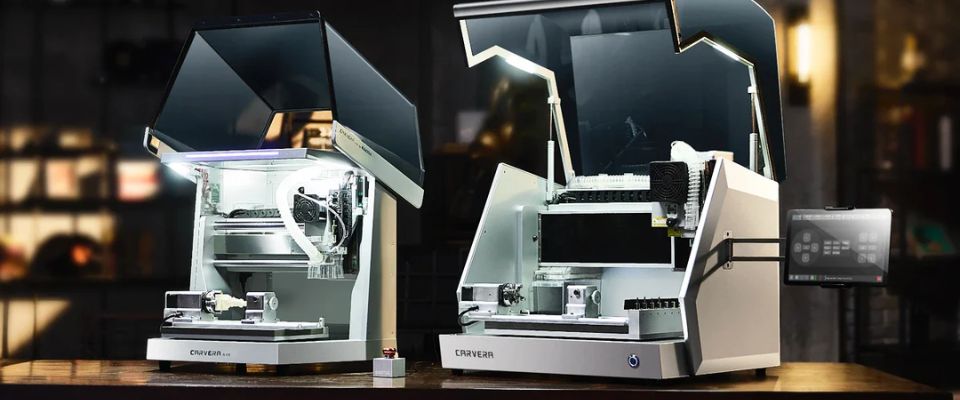
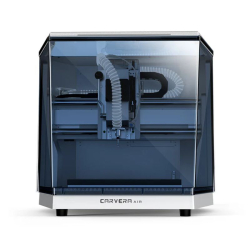
Carvera: The Complete Experience
The Makera Carvera is designed for users who want a robust machine capable of handling complex machining without compromise. It is an advanced desktop CNC featuring smart capabilities such as:
- – automatic tool changing,
- – automatic bed leveling,
- – optional 4th axis module integration,
- – compatibility with common CAM software (Fusion 360, VCarve, etc.).
Adding the rotary module enables true 4-axis CNC machining, opening creative possibilities far beyond what a standard 3-axis machine can achieve.
Carvera Air: The Accessible Compromise
The Makera Carvera Air retains the core experience of its larger counterpart, with a slightly more accessible and streamlined approach while maintaining extended machining capabilities. Key highlights include:
- – generous machining area for a desktop machine,
- – compatibility with a dedicated 4th axis module to expand working possibilities.
On this machine, the 4th axis module allows machining of cylindrical parts, double-sided components, and even complex 3D shapes, while maintaining high precision thanks to a backlash-free harmonic drive system.
A 4th Axis? Yes—But with a Learning Curve
Some common assumptions must be reconsidered when transitioning from 3-axis to a 4-axis machine:
- – More complex programming: integrating the A-axis into your G-code or 3D toolpaths requires a deeper understanding of CAM, or the use of software capable of handling multi-face machining strategies.
- – Physical limitations: even with the A-axis, the machine does not become a full 5-axis solution; extremely complex geometries may still require more advanced systems.
- – New workflow mindset: fully leveraging a 4-axis machine means thinking differently—considering the part as a complete object to be machined from all angles through rotation.
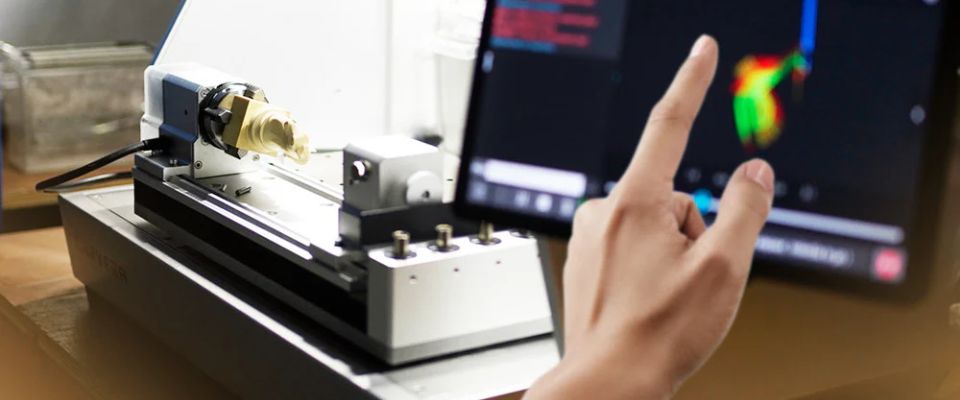
However, with tools like those from Makera, the manufacturer has integrated a range of software aids to simplify this transition, making the experience less intimidating even for less experienced users.
4-Axis CNC and Productivity: A Winning Combination When Mastered
For a modern workshop—whether focused on custom manufacturing, prototyping, or small-scale artisanal production—adding a 4th axis provides:
- – new agility in manufacturing complex parts,
- – enhanced precision by reducing intermediate handling,
- – shorter production cycles, especially for multi-face components.
It is not a magic solution: machining strategies must be rethought, programming skills developed, and a learning curve accepted. But once mastered, the gains in flexibility and creativity are significant.
Conclusion
Moving to a 4-axis CNC is a strategic decision for anyone looking to push traditional machining limits. It is no longer just about adding a feature—it is about rethinking machining processes, improving precision, reducing setup times, and gaining access to a wider range of geometries that were previously much more complex to produce.
Machines like these make this capability accessible at the desktop or workshop level, offering a gateway to more ambitious and versatile manufacturing.
✅ Why Choose Polyfab3D?
Premium Support and After-Sales Service: Starting from your needs, we will guide you to the most suitable solution and provide long-term support for its implementation and daily use.
Official Reseller: Polyfab3D is a certified reseller of top brands, ensuring you get official products, exclusive access to the latest innovations, and priority technical support.
Fast Delivery and Customer Satisfaction: Polyfab3D is committed to providing you with an optimal and fast experience. Positive feedback from our customers rewards us and proves the reliability and efficiency of our service.
Contact us now for a personalized recommendation tailored to your needs, budget, and ambitions.