




The market for laser cutters has been evolving rapidly for several years. Long reserved for industrial workshops, this technology is now accessible to craftspeople, creators, signage manufacturers, personalization professionals, and small production businesses.
With the arrival of new generations of more powerful, faster, and safer equipment, choosing a laser cutting solution suited to your needs can quickly become complex.
So, which machine should you choose for laser cutting in 2026? What criteria should you really compare before investing? And what are the most interesting solutions currently on the market?
Why has choosing a laser cutting machine become more complex in 2026?
Just a few years ago, the laser cutter market was essentially divided between a few diode systems aimed at the general public and heavy industrial equipment oriented toward professionals.
Today, manufacturers offer much more specialized solutions:
- – high-power diode systems;
- – next-generation CO₂ technologies;
- – MOPA fiber sources capable of working with metals;
- – hybrid machines combining multiple laser technologies;
- – scalable modular platforms.
This diversification makes it possible to meet more needs, but also makes the choice more technical.
A machine perfectly suited to object personalization may, for example, be unsuitable for intensive cutting of thick wood. Conversely, a system designed for industrial production may represent an unnecessarily large investment for artisanal use.
Before comparing available models, it is therefore essential to identify the criteria that truly influence performance.
The essential criteria for choosing a laser cutting machine
Laser power
Power is often the first element analyzed when making a purchase. However, you should not only look at the number of watts listed on the spec sheet.
Higher power generally allows you to:
- – cut thicker materials;
- – increase working speed;
- – reduce the number of passes required;
- – improve overall productivity.
For occasional work on thin plywood or MDF, a power of 20 W may be sufficient.
For more intensive use or thicker materials, models from 40 W to 60 W offer a significant productivity gain.
Which technology for laser cutting?
Not all laser sources work the same way.
Diode lasers
Diode systems are today the most widespread.
They offer:
- – low acquisition cost;
- – limited maintenance;
- – good versatility;
- – moderate electricity consumption.
They are perfectly suited to cutting wood, leather, cardboard, or MDF.
CO2 lasers
CO2 sources remain the benchmark for applications requiring more power. They generally offer higher cutting speeds and better interaction with certain materials commonly used in manufacturing and personalization.
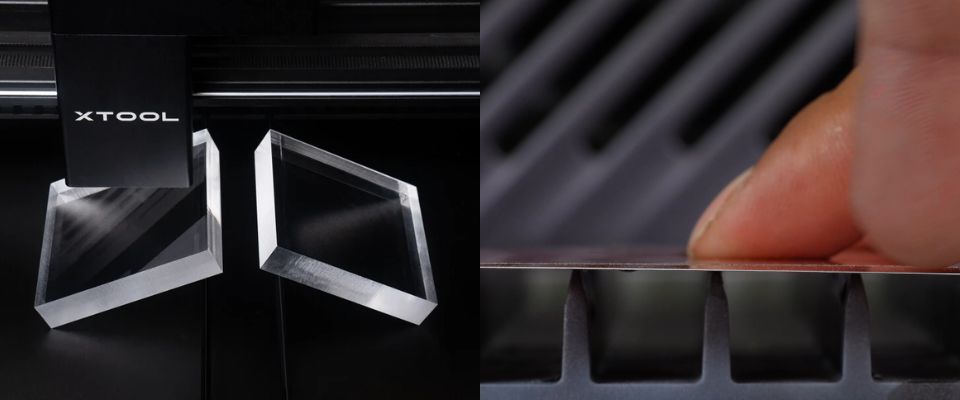
This technology is particularly distinguished by its ability to efficiently cut transparent acrylic, a material that is difficult to work with diode technologies. CO2 lasers also produce edges that are often cleaner and more consistent, an advantage particularly appreciated for parts intended to be sold or displayed.
Work area
The size of the usable area directly influences the maximum dimensions of the parts that can be produced.
A larger bed allows you to:
- process large formats;
- reduce handling;
- improve productivity in series production.
Professionals working in signage or decoration often prefer large formats in order to optimize their production cycles.
It is also important to take into account the accessories that extend the machine’s capabilities. Some manufacturers offer work stands, raised tables, bed extensions, or automatic conveyors that allow processing materials whose length far exceeds the original work area.
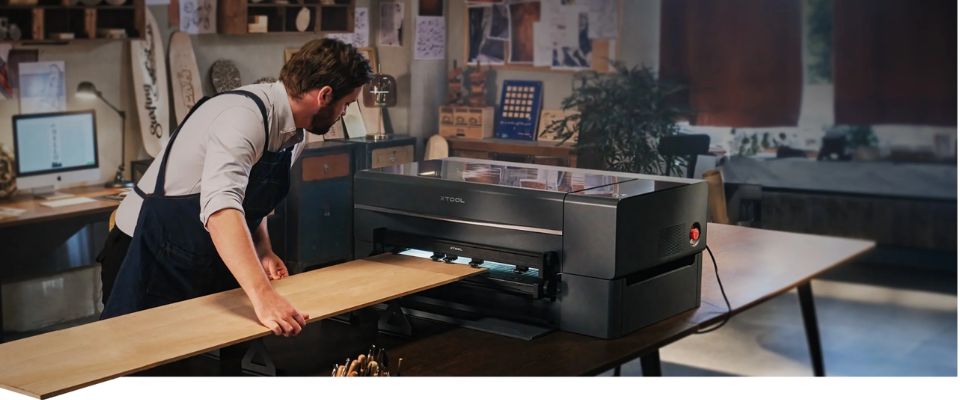
These accessories can transform a compact machine into a true production tool capable of working on panels, signs, or large decorative elements. For professionals producing series or large-format parts, the availability of these accessories is often a criterion just as important as the original bed size.
Cutting speed
Real performance does not depend solely on power. The quality of the mechanical system also plays a major role:
- – precision of guides;
- – rigidity of the frame;
- – acceleration;
- – vibration control.
A fast machine makes it possible to reduce production times and improve profitability on large series.
Compatible materials
Even before comparing the power or speed of a machine, it is essential to think about the applications you want to carry out. Wood cutting, signage manufacturing, object personalization, leather work, textile creation, or metal marking: each use involves specific materials and sometimes a different laser technology.
Plywood, MDF, solid wood, cardboard, leather, textile, PMMA, and certain metals do not all react the same way to the laser beam.
Defining the materials you will use most often allows you to steer your choice toward a machine truly suited to your needs and to avoid an investment that could quickly show its limitations.
Safety
Safety has become a central criterion in 2026. Modern equipment now integrates:
- – opening sensors
- – fire detection
- – emergency stop
- – flame monitoring
- – reinforced optical protection
For professional or shared-environment use, this criterion should never be overlooked.

➡️ Find our article on
Understanding laser classification and safety rules
Fume management and filtration
Laser cutting inevitably generates fumes, fine particles, and various volatile compounds.
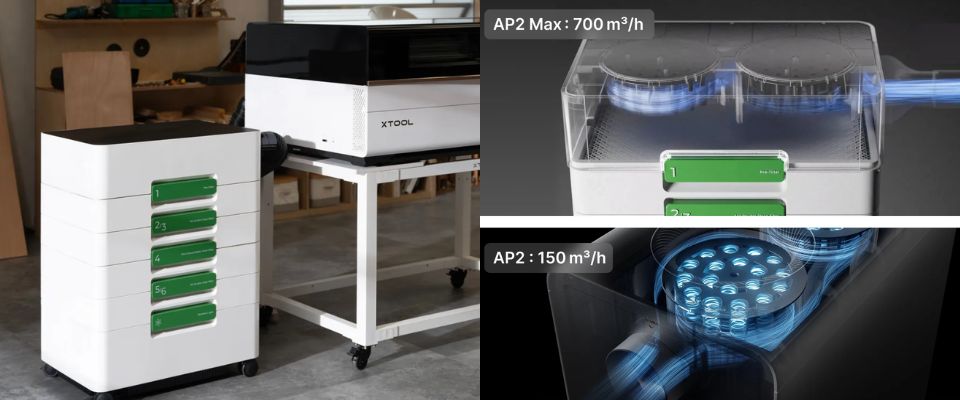
An efficient extraction and filtration system helps preserve air quality, improve working comfort, and limit the machine’s fouling. For regular use, it is often an indispensable investment.
Solutions equipped with dedicated filtration systems are often a worthwhile investment in the long term.
The software ecosystem
Often pushed to the background, software nonetheless plays an essential role in the user experience. It influences file preparation, project positioning, task automation, and series production management.
A high-performance machine is always more enjoyable to use when it relies on intuitive and comprehensive software. The user experience therefore depends as much on the software as on the hardware itself.
Laser cutting machine comparison in 2026
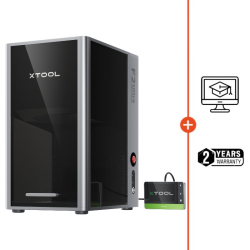
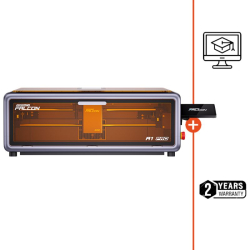
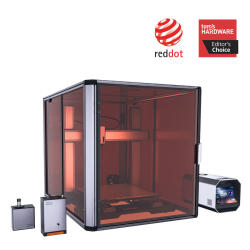
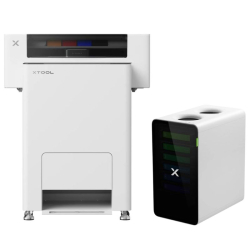
| Criteria | xTool P3 | xTool M2 20W | xTool F2 Ultra MOPA 60W + Diode 40W | Creality Falcon T1 40W | Creality Falcon 2 Pro 60W | Match result |
|---|---|---|---|---|---|---|
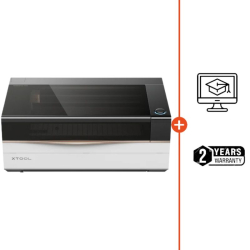
| Laser technology | CO2 80W (+ optional IR module) | Diode 20W | MOPA Fiber 60W + Diode 40W | Diode 40W | Diode 60W | Advantage F2 Ultra for its unique versatility |
| Wood and MDF cutting | Excellent, fast and clean | Suitable for thin thicknesses | Good on organic materials | Very good performance | Among the best in diode | Advantage P3 and Falcon 2 Pro |
| Transparent acrylic | Compatible thanks to CO₂ | Not compatible for cutting | Limited depending on applications | Not compatible for cutting | Not compatible for cutting | Large advantage P3 |
| Work area | 915 x 458 mm | 498 x 319 mm | 220 x 220 mm (expandable with conveyor) | Large format with available conveyor | 400 x 415 mm | Advantage P3 |
| Conveyor and continuous production | Automated smart conveyor | No | Conveyor available | Conveyor compatible | More limited functions | Advantage P3 |
| Maximum speed | Up to 1200 mm/s | Up to 600 mm/s | Up to 15000 mm/s (Galvo) | Very fast for a diode | Very fast for a diode | Large advantage F2 Ultra |
| Cameras and automation | 4 cameras, LiDAR, autofocus, ACS | Integrated camera and autofocus | Dual 48 MP AI camera | AI camera and autofocus | Autofocus and visual assistance | Advantage P3 |
| Safety | Class 1 enclosed machine with fire suppression | Secure enclosed machine | Professional enclosed machine | Secure enclosed cabinet | Enclosed cabinet with flame detection | Advantage P3 |
| Performance / price ratio | Excellent but significant investment | Very affordable | High cost but very specialized | Good power/features compromise | Very competitive at 60W | Advantage Falcon 2 Pro and M2 20W |
Which machine to choose based on your activity?
For beginners
A 20 W diode solution generally represents the best compromise between budget, simplicity, and performance.
For artisanal activity
Diode platforms from 40 W to 60 W today offer an excellent balance between operating cost and productivity.
For intensive professional activity
A large-format CO₂ machine often remains the most relevant choice thanks to its speed and versatility.
For working with metal as well
Hybrid systems integrating a MOPA fiber source make it possible to meet more varied needs while retaining cutting capabilities on organic materials.
Conclusion
Choosing a laser cutting machine in 2026 is no longer simply a matter of comparing power ratings or prices.
The technology used, the work area, the materials to be processed, the safety features, the software ecosystem, and the upgrade possibilities must all be analyzed carefully.
For occasional or artisanal use, diode systems today offer excellent performance. For production-oriented professional activity, CO₂ platforms maintain a significant lead. Finally, hybrid solutions open the door to new uses by combining multiple technologies within the same equipment.
The most important thing remains to choose a machine suited to your real needs rather than an impressive spec sheet on paper.